Cosmetic & Dermatology
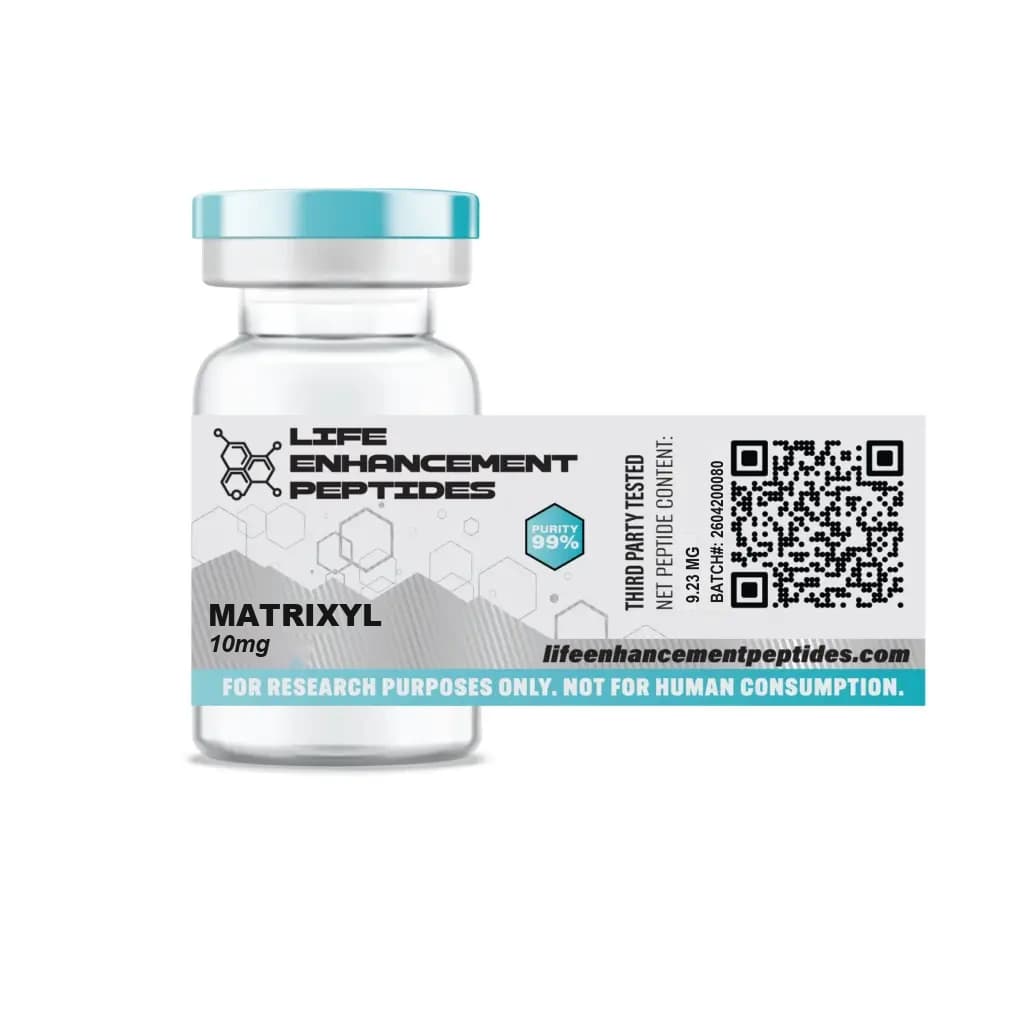
Matrixyl — 10mg
$22
Palmitoyl Pentapeptide-4 (Pal-KTTKS) — a synthetic lipopeptide derived from a procollagen I cleavage fragment, studied as a matrikine signaling molecule that upregulates collagen, fibronectin, and glycosaminoglycan synthesis in dermal fibroblasts.
 Cosmetic & Dermatology
Overview
Matrixyl is the trade name for Palmitoyl Pentapeptide-4 (Pal-KTTKS), a synthetic lipopeptide composed of the pentapeptide sequence Lys-Thr-Thr-Lys-Ser conjugated at the N-terminus to a 16-carbon palmitoyl (palmitic acid) chain. The peptide portion is a direct fragment of the type I procollagen C-propeptide — a region cleaved during collagen maturation — making Matrixyl a synthetic mimic of an endogenous matrikine, a class of peptide signaling molecules released during extracellular matrix turnover that feed back to regulate ECM synthesis. The palmitoyl conjugation increases lipophilicity dramatically, enabling stratum corneum penetration that the bare pentapeptide cannot achieve.
Mechanistically, Matrixyl functions as a matrikine that signals through dermal fibroblast surface receptors (the precise receptor identity remains an active area of research) to upregulate expression of multiple ECM constituents. In vitro studies in cultured human dermal fibroblasts have demonstrated dose-dependent increases in synthesis of type I, III, and IV collagens, fibronectin, hyaluronic acid, and other glycosaminoglycans. Beyond its synthetic-stimulating activity, biophysical studies indicate that the compound modulates a feedback loop in sparse extracellular matrix environments — promoting ECM deposition while simultaneously inhibiting excessive degradation. This dual action distinguishes it pharmacologically from passive collagen-supplementing strategies.
Research applications span dermatological aging studies, wound healing models, ECM biology, and the broader study of matrikine signaling. A landmark 2008 split-face human clinical study published in the British Journal of Dermatology demonstrated that topical Pal-KTTKS at 3 ppm produced statistically significant reductions in wrinkle depth and length compared to placebo over 12 weeks, with effects discernible by both clinical scoring and quantitative image analysis. The compound has been studied at concentrations as low as ~3 ppm in cosmeceutical formulations and at higher concentrations in research-only contexts. Current research lines focus on combinatorial protocols (Matrixyl combined with copper peptides, retinoids, or other ECM-active compounds), penetration optimization, and elucidation of the specific fibroblast receptors mediating its signaling activity.
Mechanism of Action
Acts as a matrikine — a synthetic mimic of a procollagen I C-propeptide cleavage fragment — that signals through dermal fibroblast surface receptors to upregulate type I, III, and IV collagen synthesis, fibronectin production, and glycosaminoglycan deposition; the palmitoyl moiety enables stratum corneum penetration.
Research Applications
Areas of peer-reviewed scientific inquiry where this compound has appeared.
- Dermatological aging and skin-rejuvenation research
- Extracellular matrix biology and matrikine signaling
- Dermal fibroblast receptor pharmacology
- Wound healing and tissue-remodeling models
- Comparative studies with copper peptides and retinoid-based protocols
Key Findings from the Literature
- 01Pentapeptide sequence Lys-Thr-Thr-Lys-Ser is a direct fragment of type I procollagen C-propeptide
- 02Palmitoyl conjugation enables stratum corneum penetration absent in the bare pentapeptide
- 03In vitro: dose-dependent upregulation of type I/III/IV collagens, fibronectin, and GAGs
- 042008 split-face clinical study: significant wrinkle-depth reduction at 3 ppm vs placebo over 12 weeks
- 05Bidirectional ECM feedback — promotes synthesis and limits degradation in sparse matrix environments
Certificates of Analysis1
Independent third-party lab reports for this peptide. Each CoA can be verified against its accession number at the testing lab.
1 independent test by Freedom Diagnostics Testing
| Test | Result |
|---|---|
| Purity (HPLC) | 99.67% |
| Identity (MS) | Pass |
| Endotoxins (LAL) | Pass |
Lab: Freedom Diagnostics Testing
Accession: 2604200080
Reports are verifiable against the issuing lab using the accession or batch identifier above.
Related Peptides
Other compounds in the cosmetic & dermatology category.