
Immune & Longevity
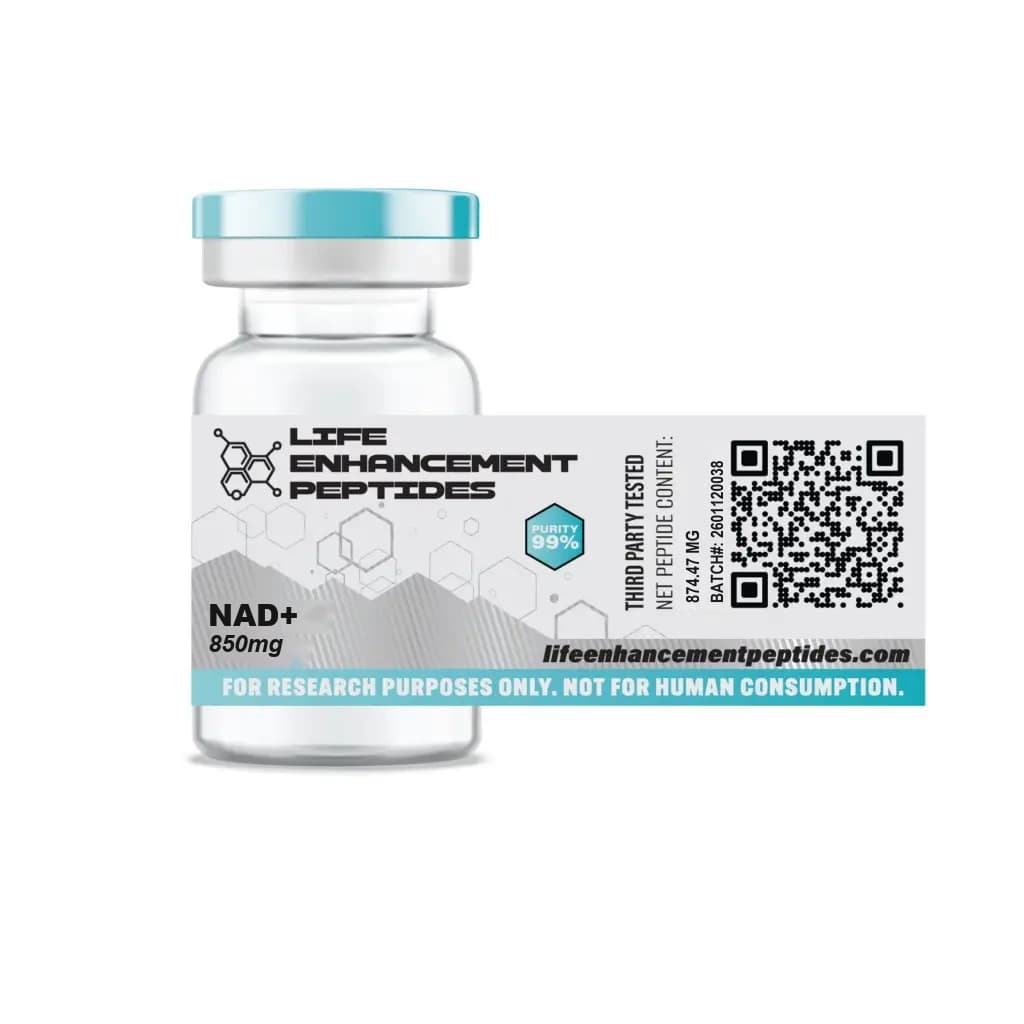
NAD+ — 850mg
$82
The high-dose format of NAD+ for research protocols requiring larger per-administration quantities of this essential redox coenzyme — the obligate substrate for sirtuin deacetylases and PARP DNA-repair enzymes.
 Immune & Longevity
Overview
Nicotinamide adenine dinucleotide (NAD+) is a universal redox cofactor present in every living cell, cycling between its oxidized (NAD+) and reduced (NADH) forms to drive electron transfer in over 500 enzymatic reactions. It is central to oxidative phosphorylation, glycolysis, the citric acid cycle, and fatty acid oxidation. Beyond energy metabolism, NAD+ is the obligate substrate for the sirtuin family of NAD+-dependent deacetylases (SIRT1–7) and for the PARP (poly-ADP-ribose polymerase) family of DNA damage repair enzymes. Intracellular NAD+ levels decline measurably with age across tissues — a phenomenon implicated in age-related metabolic dysfunction, impaired DNA repair capacity, and progressive mitochondrial decline.
Direct NAD+ supplementation has become an area of substantial research interest following preclinical demonstrations that restoring cellular NAD+ can reverse markers of aging in mouse models. Research applications include studies of sirtuin-mediated lifespan extension, PARP-driven DNA repair activation, mitochondrial biogenesis and bioenergetics, and metabolic syndromes involving defective energy metabolism. Intravenous and subcutaneous NAD+ research protocols have examined its effects on fatigue, cognitive performance, addiction recovery models, and age-related metabolic markers, though translation to large-scale clinical evidence remains an active area of investigation.
The 850mg format is intended for research protocols that require higher per-administration doses or extended dosing windows — particularly in studies examining sustained NAD+ repletion in aging or metabolic disease models. NAD+ is a small molecule rather than a peptide, and analytical testing focuses on identity confirmation and endotoxin content rather than peptide purity assays.
Mechanism of Action
Serves as the essential redox cofactor in >500 enzymatic reactions spanning oxidative phosphorylation, glycolysis, and the TCA cycle; obligate substrate for sirtuin-family deacetylases (SIRT1–7) driving lifespan and metabolic pathways; substrate for PARP-family DNA damage repair enzymes.
Research Applications
Areas of peer-reviewed scientific inquiry where this compound has appeared.
- Mitochondrial function and bioenergetics
- Sirtuin pathway activation (SIRT1–7)
- DNA damage repair via PARP signaling
- Age-related cognitive and metabolic decline
- Cellular senescence and longevity research
Key Findings from the Literature
- 01Required for >500 enzymatic reactions across human metabolism
- 02Intracellular NAD+ levels decline measurably with aging
- 03Obligate substrate for sirtuin and PARP enzyme families
- 04Preclinical models show restoration of NAD+ can reverse aging biomarkers
- 05Higher-dose format supports sustained-repletion research protocols
Quality Control
Supplied under manufacturer QC to USP standards. This item is a vitamin and is tested to pharmacopoeial specifications rather than peptide HPLC purity assay.
Related Peptides
Other compounds in the immune & longevity category.
 immune longevity
Epitalon
50mg
A synthetic tetrapeptide from the pineal gland that activates telomerase in human somatic cells, demonstrating measurable telomere lengthening in elderly human subjects — one of the few compounds with direct clinical evidence of telomere biology modulation.
 immune longevity
Thymosin Alpha-1
10mg
A 28-amino acid thymus-derived peptide approved in over 35 countries as Zadaxin, with substantial clinical evidence for viral infection treatment, cancer immunotherapy synergy, and vaccine response enhancement.
 immune longevity
SS-31
50mg
A mitochondria-targeted tetrapeptide that binds cardiolipin on the inner mitochondrial membrane, preserving electron transport chain function and reducing reactive oxygen species — approved in 2024 as elamipretide (Forzinity) for Barth syndrome.