
Tissue Repair & Recovery
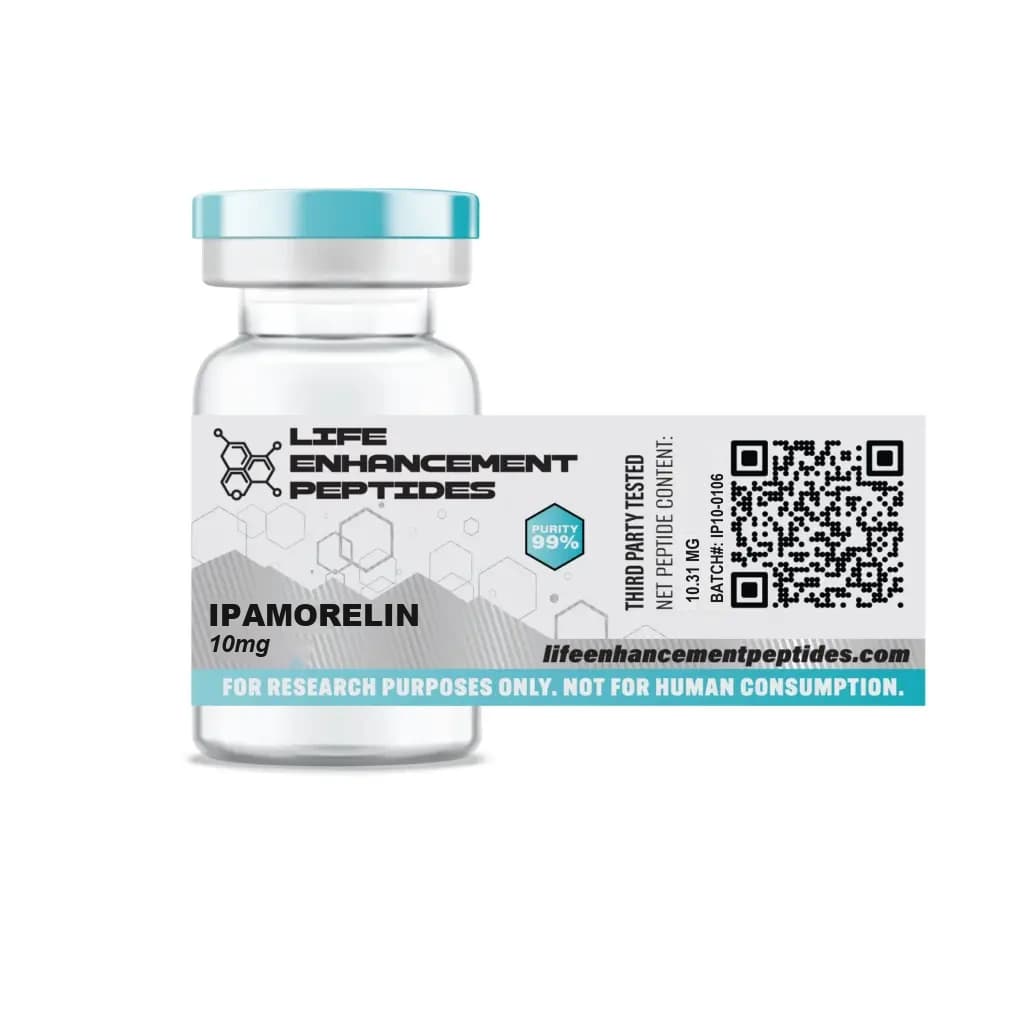
Ipamorelin — 10mg
$54
The most selective ghrelin receptor agonist characterized to date — a pentapeptide growth hormone secretagogue that produces robust GH pulses without the cortisol, prolactin, or aldosterone elevation of earlier GHRPs.
 Tissue Repair & Recovery
Overview
Ipamorelin is a synthetic pentapeptide ghrelin receptor (GHSR-1a) agonist developed by Novo Nordisk in the late 1990s as a refined growth hormone secretagogue. Its defining property is selectivity: unlike earlier GHRPs (GHRP-2, GHRP-6, hexarelin), which produce significant elevations in cortisol, prolactin, and occasionally aldosterone alongside growth hormone (GH), Ipamorelin produces essentially clean GH release with no clinically meaningful effect on other pituitary axes. This selectivity made it a pharmacological probe for dissecting the ghrelin receptor's GH-releasing function from its broader endocrine effects, and has positioned it as the preferred GHS in research contexts where hormonal interference would confound interpretation.
At the receptor level, Ipamorelin binds GHSR-1a on pituitary somatotropes with high affinity, triggering Gq-coupled signaling that depolarizes the cell and drives GH secretion. The peptide also suppresses somatostatin tone — the physiological brake on GH release — which amplifies the GH pulse. Its pentapeptide structure (Aib-His-D-2-Nal-D-Phe-Lys-NH₂) is compact enough for reliable subcutaneous bioavailability with a half-life of approximately two hours, supporting flexible dosing protocols typically administered before sleep (to align with endogenous slow-wave-sleep GH pulses) or post-exercise.
Research applications span body composition and recovery contexts, age-related GH decline (somatopause), sleep architecture, and fracture healing where local GH/IGF-1 signaling accelerates callus formation. Ipamorelin is frequently studied as a monotherapy in protocols where clean GH signaling is needed for mechanistic analysis, or in combination with a GHRH-class peptide (CJC-1295, sermorelin, tesamorelin) where the two mechanisms synergize to produce pulsatile GH release mimicking endogenous patterns. Its clean pharmacological profile has also made it a reference compound against which newer ghrelin receptor agonists are benchmarked.
Mechanism of Action
Selectively binds GHSR-1a on pituitary somatotropes to drive Gq-coupled GH release; suppresses somatostatin tone to amplify the GH pulse; does not activate receptors driving cortisol, prolactin, or aldosterone release.
Research Applications
Areas of peer-reviewed scientific inquiry where this compound has appeared.
- Body composition and recovery research
- Age-related GH decline (somatopause)
- Sleep architecture and slow-wave sleep research
- Fracture healing and bone remodeling
- Ghrelin receptor pharmacology
Key Findings from the Literature
- 01Most selective GHS characterized — clean GH release without cortisol or prolactin elevation
- 02~2-hour half-life supports flexible subcutaneous dosing
- 03Pentapeptide structure with reliable bioavailability
- 04Suppresses somatostatin tone to amplify GH pulse
- 05Reference compound for ghrelin receptor agonist research
Certificates of Analysis1
Independent third-party lab reports for this peptide. Each CoA can be verified against its accession number at the testing lab.
1 independent test by Janoshik Analytical
| Test | Result |
|---|---|
| Purity (HPLC) | 99.780% |
| Identity (MS) | Pass |
| Endotoxins (LAL) | Not Tested |
Lab: Janoshik Analytical
Accession: LDWJLKZ7JKFU
Reports are verifiable against the issuing lab using the accession or batch identifier above.
Related Peptides
Other compounds in the tissue repair & recovery category.
 tissue repair
BPC-157
10mg
A 15-amino acid pentadecapeptide derived from human gastric juice, studied for its remarkable capacity to accelerate healing across musculoskeletal, gastrointestinal, and neural tissues.
 tissue repair
BPC-157
20mg
The higher-dose format of BPC-157 for research protocols requiring extended treatment windows or higher per-administration quantities of this gastric-derived pentadecapeptide.
 tissue repair
TB-500
10mg
A synthetic fragment of Thymosin Beta-4 corresponding to the actin-binding domain, extensively studied for its role in cardiac angiogenesis, soft tissue healing, and corneal regeneration.