
Cognitive & Neurological
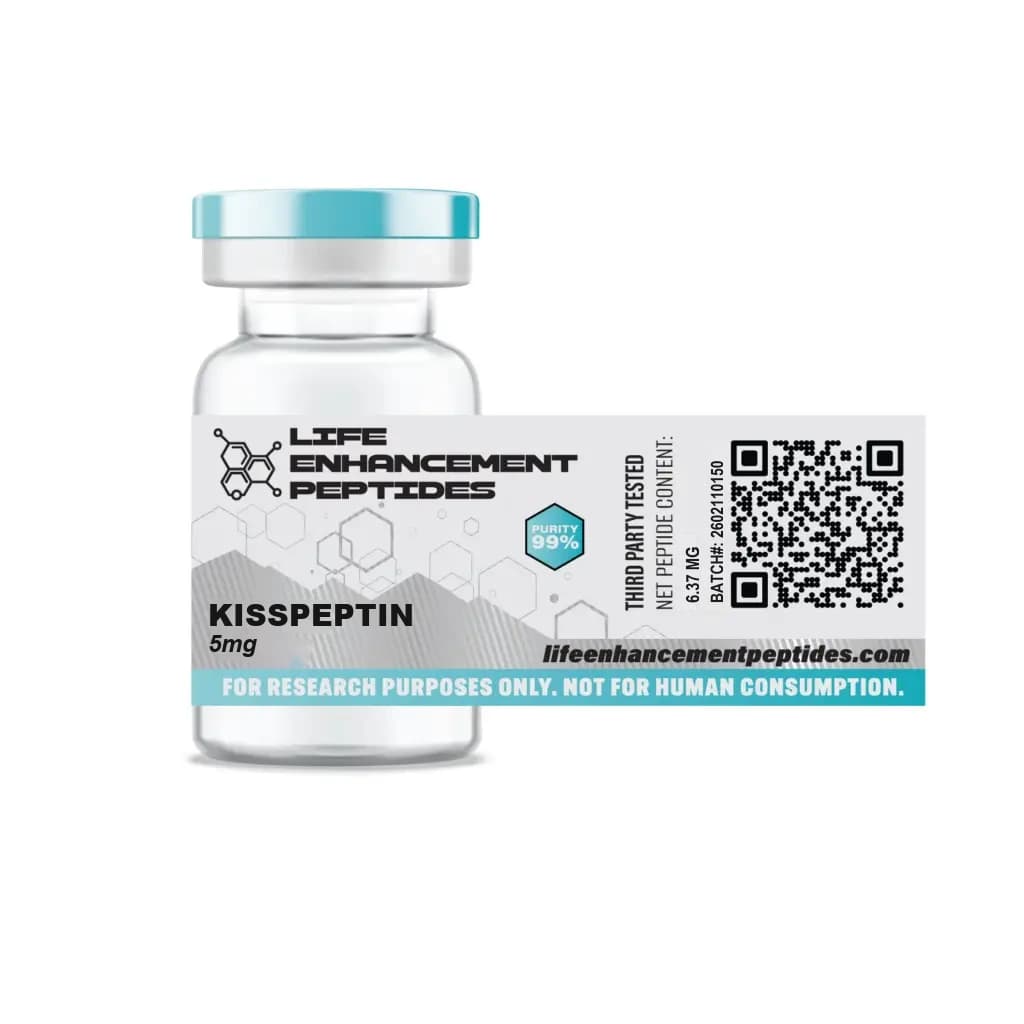
Kisspeptin — 5mg
$45
The master upstream regulator of GnRH neurons and the hypothalamic-pituitary-gonadal axis, studied as a fertility-restoring compound with emerging applications in hypogonadism and reproductive medicine research.
 Cognitive & Neurological
Overview
Kisspeptin is the product of the KISS1 gene and acts as the primary upstream regulator of gonadotropin-releasing hormone (GnRH) neurons in the hypothalamus. Its discovery reshaped reproductive endocrinology: before kisspeptin was characterized, the mechanism that triggered puberty and controlled GnRH pulsatility throughout reproductive life was largely unknown. Loss-of-function mutations in KISS1 or its receptor (KISS1R/GPR54) produce hypogonadotropic hypogonadism and failure to undergo puberty, definitively establishing the peptide's role as the master switch of the reproductive axis.
At the receptor level, kisspeptin binds KISS1R on GnRH neurons in the preoptic area and arcuate nucleus, triggering Gq-coupled signaling cascades that depolarize the neurons and drive pulsatile GnRH secretion. The pulsatility pattern — not just the absolute GnRH level — determines downstream LH and FSH release from the pituitary, which in turn governs ovarian or testicular function. Two anatomically distinct kisspeptin neuron populations manage different aspects of this axis: the arcuate population is responsible for negative feedback-driven pulsatility, while the preoptic population mediates the preovulatory LH surge in females.
Research applications have expanded well beyond the initial reproductive endocrinology focus. Kisspeptin has been investigated as a fertility-restoring agent in hypothalamic amenorrhea, as an alternative to hCG triggers in IVF protocols (where it produces ovarian hyperstimulation syndrome less frequently), and as a diagnostic probe for reproductive axis function. Parallel lines of investigation have examined its role in metabolism-reproduction coupling — kisspeptin neurons integrate leptin signaling, connecting energy status to fertility — and in neuropsychiatric research, where KISS1R expression in limbic structures suggests roles in emotional and social processing that extend beyond classical reproductive function.
Mechanism of Action
Binds KISS1R (GPR54) on GnRH neurons to drive pulsatile GnRH secretion via Gq-coupled depolarization; integrates leptin and metabolic signaling to couple energy status with reproductive function.
Research Applications
Areas of peer-reviewed scientific inquiry where this compound has appeared.
- Hypothalamic amenorrhea and functional hypogonadism
- In vitro fertilization (IVF) trigger protocols
- Reproductive axis diagnostics
- Puberty disorders and delayed puberty
- Metabolism-reproduction coupling research
- Neuropsychiatric and limbic system research
Key Findings from the Literature
- 01KISS1/KISS1R loss-of-function produces congenital hypogonadotropic hypogonadism
- 02Master upstream regulator of the hypothalamic-pituitary-gonadal axis
- 03Lower OHSS incidence than hCG in IVF trigger protocols
- 04Integrates leptin signaling — mechanism for energy-status-dependent fertility
- 05Two distinct neuron populations manage pulsatility vs ovulatory surge
Certificates of Analysis1
Independent third-party lab reports for this peptide. Each CoA can be verified against its accession number at the testing lab.
1 independent test by Freedom Diagnostics Testing
| Test | Result |
|---|---|
| Purity (HPLC) | 99.776% |
| Identity (MS) | Pass |
| Endotoxins (LAL) | Pass |
Lab: Freedom Diagnostics Testing
Accession: 2602110150 / 2602110151
Reports are verifiable against the issuing lab using the accession or batch identifier above.
Related Peptides
Other compounds in the cognitive & neurological category.
 cognitive
Selank
10mg
A synthetic analog of the immunopeptide Tuftsin with anxiolytic potency comparable to benzodiazepines, but without tolerance, dependence, or the cognitive impairment characteristic of classical GABA-A modulators.
 cognitive
Semax
10mg
A synthetic ACTH(4-10) heptapeptide derivative approved in Russia for stroke treatment, with documented improvements in attention and short-term memory and emerging evidence for inhibiting amyloid fiber assembly.
 cognitive
PT-141
10mg
A synthetic melanocortin receptor agonist (bremelanotide) FDA-approved for hypoactive sexual desire disorder in premenopausal women — acting centrally on MC3R and MC4R in the paraventricular nucleus rather than through peripheral vascular mechanisms.