
Cognitive & Neurological
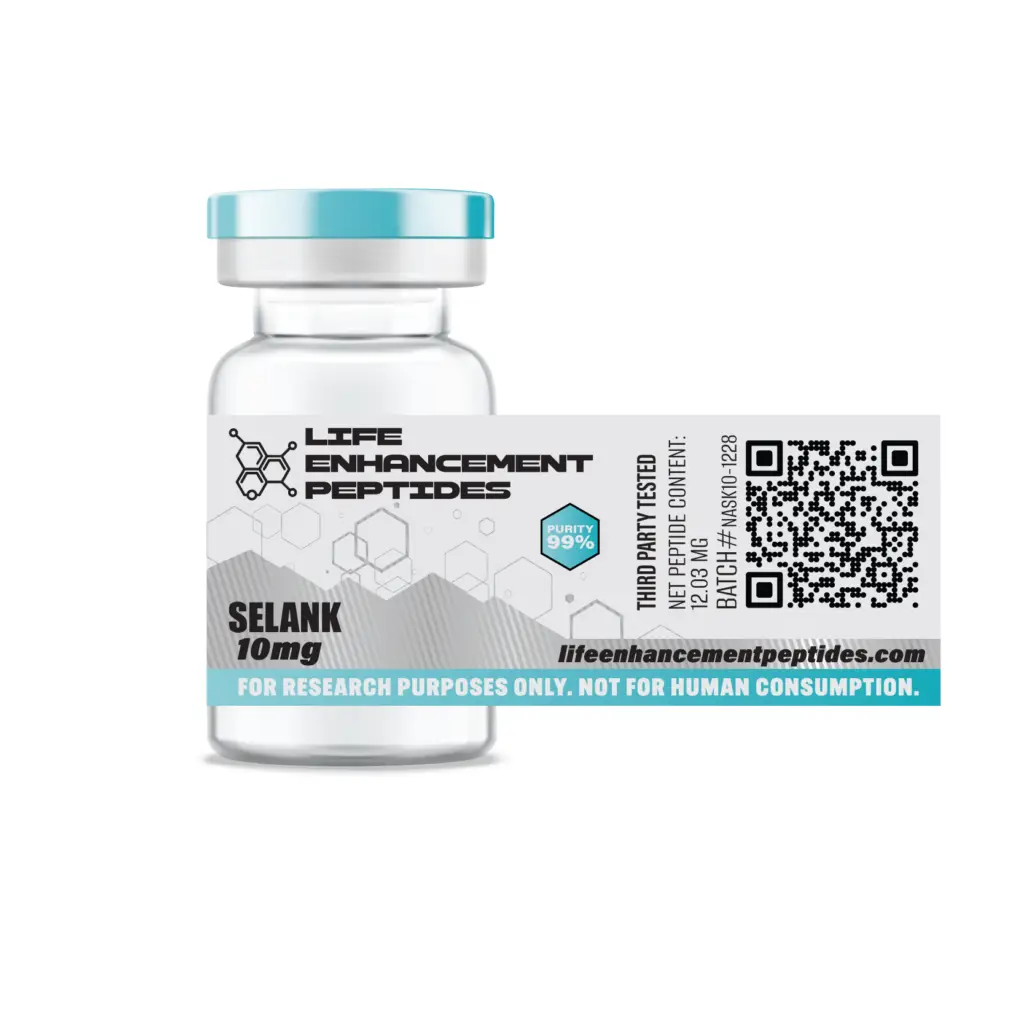
Selank — 10mg
$45
A synthetic analog of the immunopeptide Tuftsin with anxiolytic potency comparable to benzodiazepines, but without tolerance, dependence, or the cognitive impairment characteristic of classical GABA-A modulators.
 Cognitive & Neurological
Overview
Selank (Thr-Lys-Pro-Arg-Pro-Gly-Pro) is a heptapeptide developed by the Russian Institute of Molecular Genetics as a synthetic analog of Tuftsin, an endogenous tetrapeptide fragment of IgG. The addition of a Pro-Gly-Pro C-terminal sequence dramatically improves stability against peptidase degradation compared to native Tuftsin, enabling meaningful CNS exposure. Selank is approved in Russia for anxiety and cognitive disorders and has been the subject of controlled trials that provide a stronger evidence base than is typical for research peptides.
Its anxiolytic mechanism differs fundamentally from benzodiazepines despite sharing the GABA-A receptor as a target: Selank acts as a positive allosteric modulator at the benzodiazepine binding site but without the full agonist efficacy that drives tolerance development and physical dependence. Alongside this GABAergic effect, it elevates BDNF levels in the hippocampus, influences dopaminergic and serotonergic tone, and inhibits enkephalinase — the enzyme that degrades endogenous enkephalins — extending the duration of endogenous opioid-like calm without receptor activation by an exogenous agonist.
Controlled studies have demonstrated anxiolytic effects comparable to medazepam (a classical benzodiazepine) in generalized anxiety models, without the sedation, motor impairment, or withdrawal phenomena associated with full GABA-A agonists. Under chronic mild stress paradigms, Selank has been shown to enhance the efficacy of co-administered diazepam, suggesting synergistic rather than redundant mechanisms. Its immune-modulatory effects inherited from the Tuftsin scaffold add a further dimension of biological interest.
Mechanism of Action
Positive allosteric modulation of GABA-A receptors at the benzodiazepine site without full agonist tolerance liability; elevates hippocampal BDNF; modulates dopaminergic and serotonergic systems; inhibits enkephalinase to prolong endogenous opioid signaling.
Research Applications
Areas of peer-reviewed scientific inquiry where this compound has appeared.
- Anxiety and stress response research
- Cognitive enhancement and nootropic investigation
- Depression and mood disorder models
- Neuroprotection
- Immune modulation via Tuftsin-like activity
Key Findings from the Literature
- 01Anxiolytic potency comparable to benzodiazepines without tolerance or dependence
- 02No cognitive impairment or sedation at anxiolytic doses
- 03Enhances diazepam efficacy under chronic mild stress — synergistic mechanism
- 04Elevated hippocampal BDNF expression in rodent studies
- 05Approved in Russia for anxiety and cognitive disorder treatment
Certificates of Analysis1
Independent third-party lab reports for this peptide. Each CoA can be verified against its accession number at the testing lab.
1 independent test by Janoshik Analytical
| Test | Result |
|---|---|
| Purity (HPLC) | 99.833% |
| Identity (MS) | Pass |
| Endotoxins (LAL) | Not Tested |
Lab: Janoshik Analytical
Accession: FJE2RR9Y56GB
Reports are verifiable against the issuing lab using the accession or batch identifier above.
Related Peptides
Other compounds in the cognitive & neurological category.
 cognitive
Semax
10mg
A synthetic ACTH(4-10) heptapeptide derivative approved in Russia for stroke treatment, with documented improvements in attention and short-term memory and emerging evidence for inhibiting amyloid fiber assembly.
 cognitive
Kisspeptin
5mg
The master upstream regulator of GnRH neurons and the hypothalamic-pituitary-gonadal axis, studied as a fertility-restoring compound with emerging applications in hypogonadism and reproductive medicine research.
 cognitive
PT-141
10mg
A synthetic melanocortin receptor agonist (bremelanotide) FDA-approved for hypoactive sexual desire disorder in premenopausal women — acting centrally on MC3R and MC4R in the paraventricular nucleus rather than through peripheral vascular mechanisms.