
Cognitive & Neurological
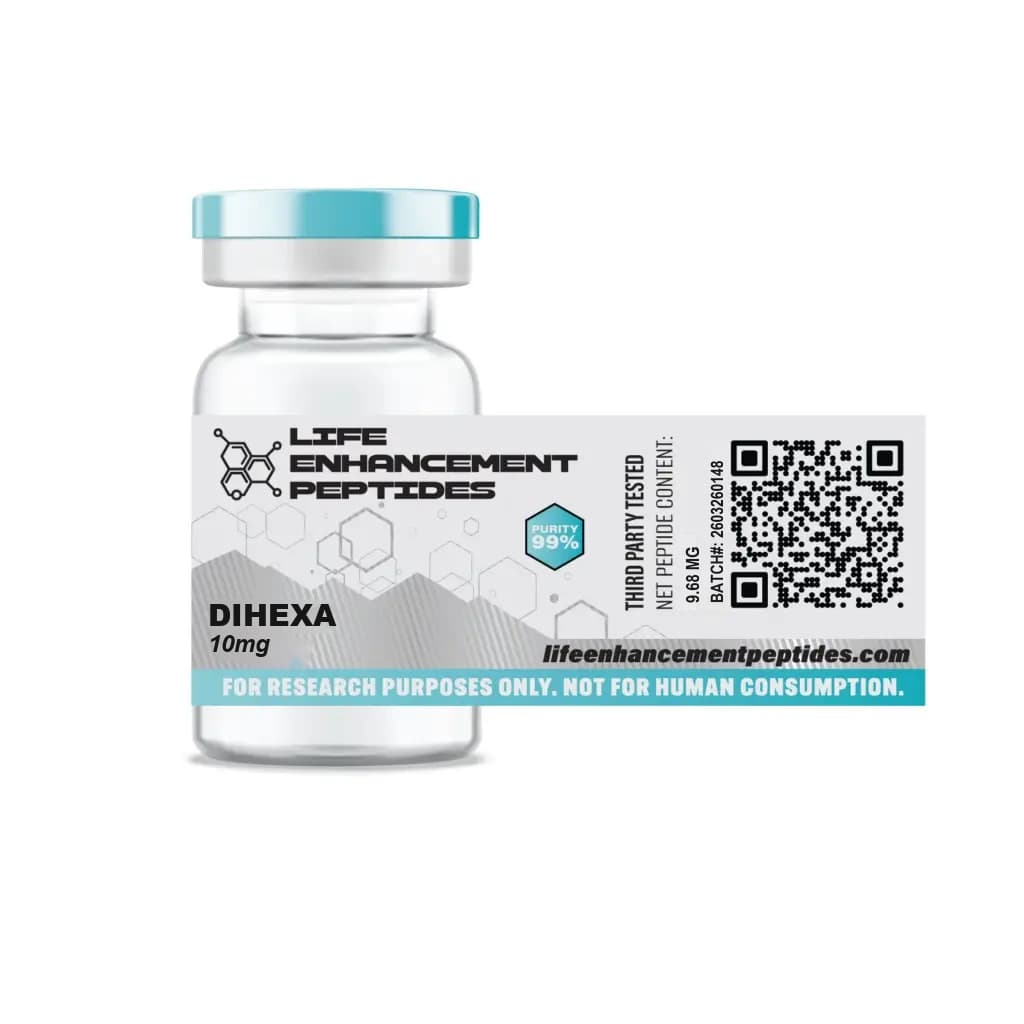
Dihexa — 10mg
$66
A hexapeptide derivative of angiotensin IV developed at Washington State University that activates hepatocyte growth factor (HGF) / c-Met signaling in the CNS — reported in preclinical studies to be orders of magnitude more potent than BDNF in dendritic spine formation.
 Cognitive & Neurological
Overview
Dihexa (N-hexanoic-Tyr-Ile-(6)aminohexanoic amide) is a hexapeptide derivative of angiotensin IV developed at Washington State University by the Harding and Wright laboratories. Its development began with the observation that angiotensin IV, a metabolic product of the renin-angiotensin system, produces cognitive enhancement effects in animal models of learning and memory. Structural optimization to improve metabolic stability, blood-brain barrier penetration, and oral bioavailability produced Dihexa as the lead candidate from this program, with pharmacological properties substantially distinct from its angiotensin-family origin.
The compound's primary mechanism involves activation of hepatocyte growth factor (HGF) / c-Met receptor signaling in the central nervous system. HGF is a potent synaptogenic factor that drives dendritic spine formation, synapse maturation, and neuronal survival, but does not cross the blood-brain barrier effectively as a large protein — making it difficult to use therapeutically despite its biological activity. Dihexa functions as a small-molecule HGF activator that potentiates c-Met signaling and is orally bioavailable with BBB penetration via transcellular transport. Published preclinical studies report dendritic spine formation potency in the range of 10⁷-fold greater than BDNF on a molar basis — a figure that has generated both intense research interest and appropriate skepticism regarding reproducibility and translation to clinical outcomes.
Research applications center on neurodegenerative disease models, particularly Alzheimer's disease, where cognitive improvements and reductions in amyloid-associated pathology have been reported in animal protocols. Parallel lines of investigation have examined Dihexa in stroke recovery, traumatic brain injury, and age-related cognitive decline models. The compound remains in preclinical research without published human clinical trials, and its characterization is ongoing — particularly with respect to long-term safety, tissue distribution, and dose-response in chronic administration protocols. Its combination of oral bioavailability, BBB penetration, and HGF/c-Met selectivity makes it a mechanistically attractive research tool, but claims of unprecedented synaptogenic potency warrant cautious interpretation pending independent replication and human data.
Mechanism of Action
Activates hepatocyte growth factor (HGF) / c-Met receptor signaling in the CNS to drive dendritic spine formation and synaptic plasticity; orally bioavailable with blood-brain barrier penetration via transcellular transport.
Research Applications
Areas of peer-reviewed scientific inquiry where this compound has appeared.
- Alzheimer's disease and neurodegeneration models
- Age-related cognitive decline
- Traumatic brain injury and stroke recovery
- Synaptic plasticity and dendritic spine research
- HGF/c-Met signaling pharmacology
Key Findings from the Literature
- 01Hexapeptide derivative of angiotensin IV — developed at Washington State University
- 02Reported 10⁷-fold greater potency than BDNF in dendritic spine formation assays
- 03Orally bioavailable with blood-brain barrier penetration
- 04Cognitive improvements documented in Alzheimer's animal models
- 05Preclinical-stage compound — no published human clinical trials to date
Certificates of Analysis1
Independent third-party lab reports for this peptide. Each CoA can be verified against its accession number at the testing lab.
1 independent test by Freedom Diagnostics Testing
| Test | Result |
|---|---|
| Purity (HPLC) | 98.536% |
| Identity (MS) | Pass |
| Endotoxins (LAL) | Pass |
Lab: Freedom Diagnostics Testing
Accession: 2603260148
Reports are verifiable against the issuing lab using the accession or batch identifier above.
Related Peptides
Other compounds in the cognitive & neurological category.
 cognitive
Selank
10mg
A synthetic analog of the immunopeptide Tuftsin with anxiolytic potency comparable to benzodiazepines, but without tolerance, dependence, or the cognitive impairment characteristic of classical GABA-A modulators.
 cognitive
Semax
10mg
A synthetic ACTH(4-10) heptapeptide derivative approved in Russia for stroke treatment, with documented improvements in attention and short-term memory and emerging evidence for inhibiting amyloid fiber assembly.
 cognitive
Kisspeptin
5mg
The master upstream regulator of GnRH neurons and the hypothalamic-pituitary-gonadal axis, studied as a fertility-restoring compound with emerging applications in hypogonadism and reproductive medicine research.