
Cognitive & Neurological
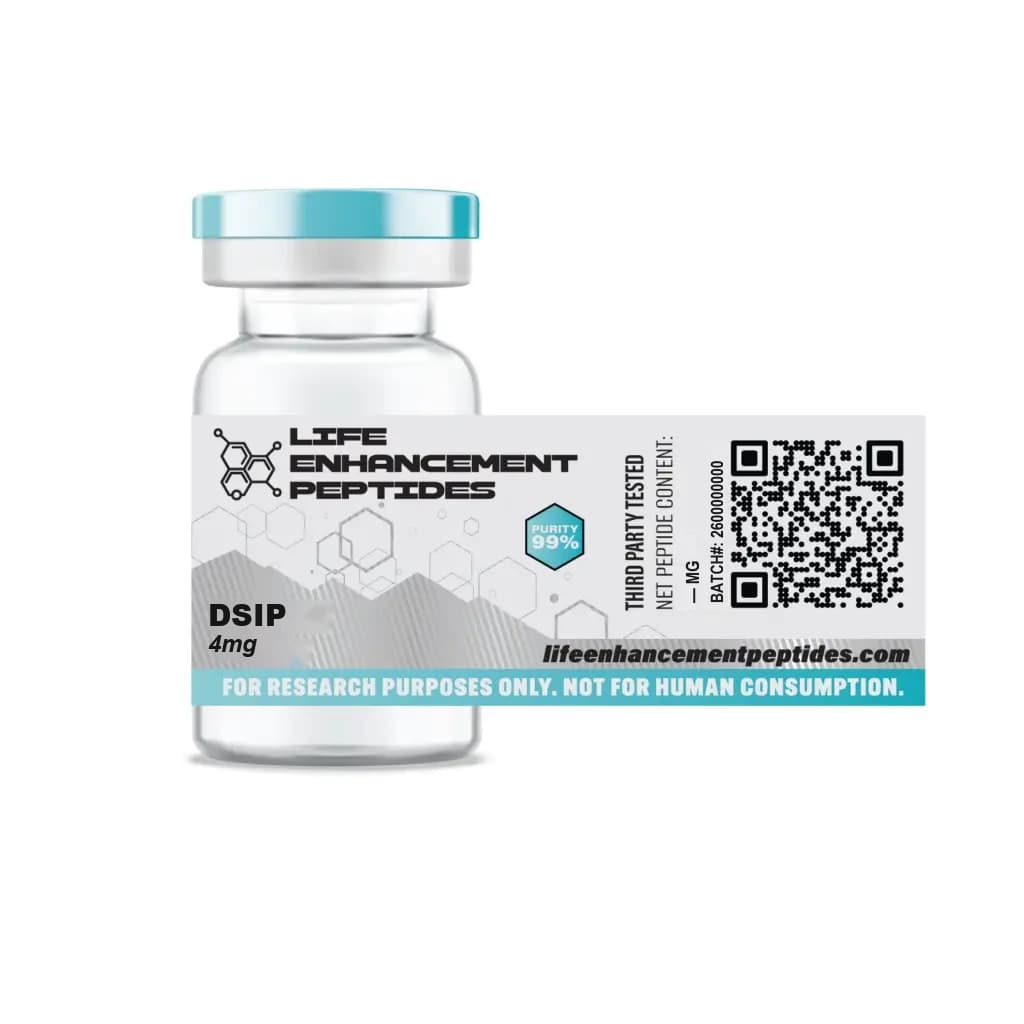
DSIP — 4mg
$27
Delta Sleep-Inducing Peptide — a 9-amino acid neuropeptide originally isolated from cerebral venous blood of rabbits during electrically induced slow-wave sleep, studied for its effects on sleep architecture, stress adaptation, and neuroendocrine modulation.
 Cognitive & Neurological
Overview
Delta Sleep-Inducing Peptide (DSIP) is a 9-amino acid neuropeptide (Trp-Ala-Gly-Gly-Asp-Ala-Ser-Gly-Glu) first isolated in 1977 by the Schoenenberger–Monnier group at the University of Basel from cerebral venous blood of rabbits during electrically induced slow-wave sleep. Its discovery emerged from attempts to identify humoral factors that transfer sleep states across organisms, and early research demonstrated that administration to recipient animals produced increases in electroencephalographic delta-wave activity — the hallmark of deep, restorative sleep.
Unlike classical sleep-regulating neurotransmitters, DSIP does not act on GABAergic or adenosinergic pathways directly. Its mechanism is pleiotropic and not fully characterized: research has implicated it in modulation of corticotropin-releasing hormone (CRH) and the hypothalamic-pituitary-adrenal (HPA) axis, interaction with opioidergic signaling, and influence on circadian rhythm through effects on the suprachiasmatic nucleus. It also produces measurable effects on thyroid and growth hormone secretion in animal models, suggesting a broader neuroendocrine role beyond sleep regulation.
Research applications have extended well beyond the sleep-initiating effects that gave DSIP its name. Studies have examined its effects on chronic stress adaptation, withdrawal syndromes in animal models of opioid and alcohol dependence, pain threshold modulation, and post-traumatic and depressive-type behavioral endpoints. The peptide's extremely short plasma half-life (estimated in minutes) has been a persistent challenge for research translation, and its endogenous function remains debated — some investigators question whether it exists at physiologically relevant concentrations in human brain tissue. Despite these uncertainties, it remains an active subject of neurophysiological research, particularly in sleep architecture and HPA-axis studies.
Mechanism of Action
Modulates corticotropin-releasing hormone (CRH) release and HPA-axis activity; interacts with opioidergic signaling pathways; influences circadian regulation via the suprachiasmatic nucleus; produces increases in EEG delta-wave (slow-wave sleep) activity in animal models.
Research Applications
Areas of peer-reviewed scientific inquiry where this compound has appeared.
- Sleep architecture and slow-wave sleep research
- HPA-axis and stress adaptation studies
- Opioid and alcohol withdrawal models
- Pain threshold modulation
- Circadian rhythm research
Key Findings from the Literature
- 01First isolated in 1977 from cerebral venous blood during induced slow-wave sleep
- 02Increases EEG delta-wave activity in recipient animals
- 03Modulates HPA-axis signaling and CRH release
- 04Implicated in opioid withdrawal amelioration in preclinical models
- 05Extremely short plasma half-life limits clinical translation
Certificates of Analysis
Independent third-party lab reports for this peptide. Each CoA can be verified against its accession number at the testing lab.
Certificates of analysis for DSIP are being processed. Every batch is independently tested before release.
Learn about our testing processRelated Peptides
Other compounds in the cognitive & neurological category.
 cognitive
Selank
10mg
A synthetic analog of the immunopeptide Tuftsin with anxiolytic potency comparable to benzodiazepines, but without tolerance, dependence, or the cognitive impairment characteristic of classical GABA-A modulators.
 cognitive
Semax
10mg
A synthetic ACTH(4-10) heptapeptide derivative approved in Russia for stroke treatment, with documented improvements in attention and short-term memory and emerging evidence for inhibiting amyloid fiber assembly.
 cognitive
Kisspeptin
5mg
The master upstream regulator of GnRH neurons and the hypothalamic-pituitary-gonadal axis, studied as a fertility-restoring compound with emerging applications in hypogonadism and reproductive medicine research.