
Cognitive & Neurological
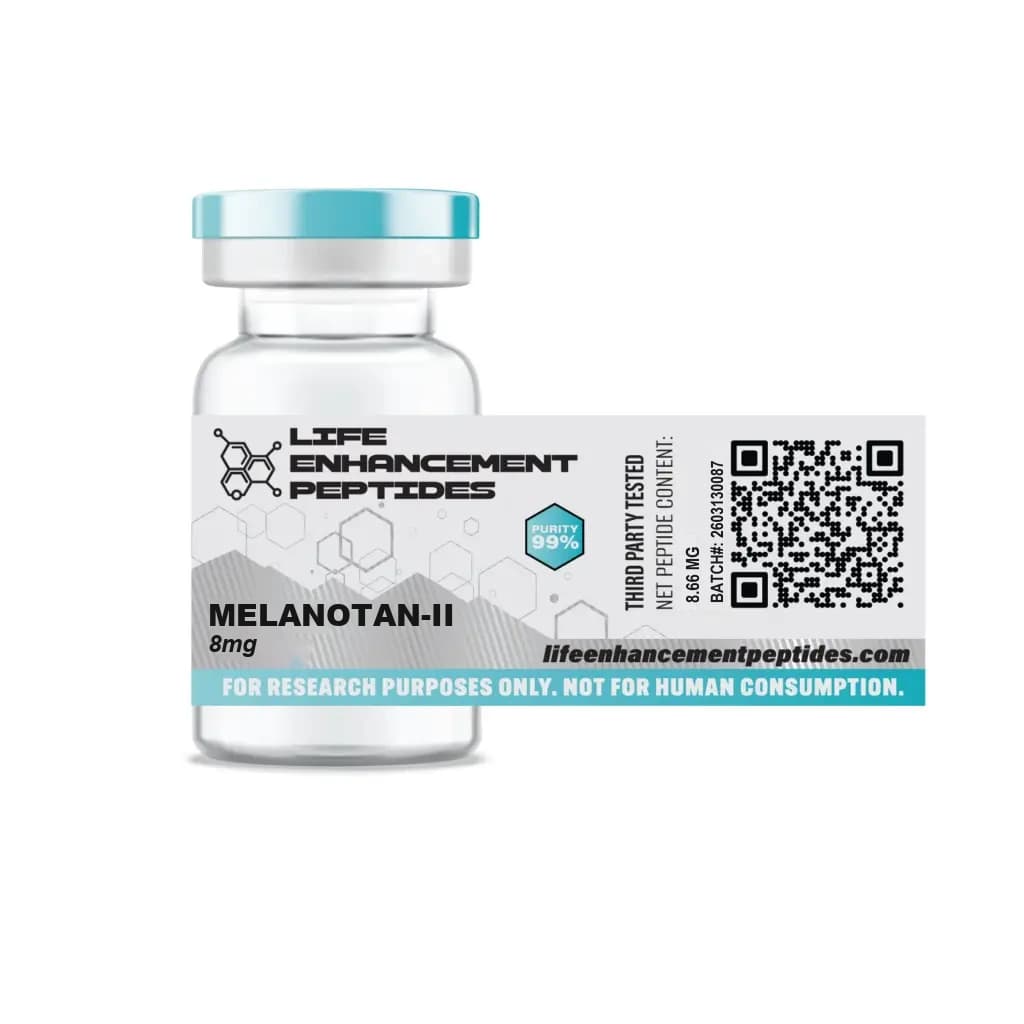
Melanotan-II — 8mg
$33
A synthetic cyclic analog of alpha-MSH with broad melanocortin receptor agonism — originally developed at the University of Arizona for photoprotection research, now studied across pigmentation, sexual function, and appetite regulation.
 Cognitive & Neurological
Overview
Melanotan-II (MT-II) is a synthetic cyclic heptapeptide analog of alpha-melanocyte-stimulating hormone (α-MSH), developed at the University of Arizona in the 1980s as a photoprotective research compound. Its cyclic lactam structure — formed by an amide bond between Asp⁵ and Lys¹⁰ — confers high metabolic stability and broad-spectrum melanocortin receptor agonism across MC1R, MC3R, MC4R, and MC5R. The original research aim was to produce endogenous melanin synthesis via MC1R activation as a mechanism for skin cancer prevention through increased natural pigmentation, a direction that has produced both academic research and substantial off-label use of the compound.
Mechanistically, MT-II's activity spans multiple melanocortin-mediated pathways. MC1R activation in melanocytes drives eumelanin synthesis, producing darkening of skin and hair independent of UV exposure. MC3R and MC4R activation in the central nervous system modulates appetite (producing anorexic effects) and sexual arousal — the latter observation eventually led to the structural refinement of MT-II into PT-141 (bremelanotide), which selectively targets the sexual function pathway. MC5R activation produces effects on exocrine gland function and lipolysis that are still being characterized in research contexts.
The compound's broad receptor profile is both its research utility and its practical complication. Because it simultaneously activates multiple melanocortin pathways, subjects frequently experience concurrent effects — pigmentation changes, appetite suppression, spontaneous erections in males, nausea — that must be accounted for in any research protocol. MT-II is not FDA-approved for any indication, and its successor compounds (PT-141 for HSDD, afamelanotide/Scenesse for erythropoietic protoporphyria) have inherited narrow-indication regulatory pathways. Research applications today focus on the mechanistic study of melanocortin receptor pharmacology, photoprotection research in dermatology, and comparative studies against selective melanocortin agonists.
Mechanism of Action
Broad melanocortin receptor agonism across MC1R (melanogenesis), MC3R and MC4R (appetite and sexual arousal), and MC5R (exocrine and lipolytic effects); cyclic lactam structure confers metabolic stability and high receptor affinity.
Research Applications
Areas of peer-reviewed scientific inquiry where this compound has appeared.
- Photoprotection and skin cancer prevention research
- Melanocortin receptor pharmacology
- Appetite regulation and MC3R/MC4R-mediated satiety
- Sexual function research (predecessor to PT-141)
- Erythropoietic protoporphyria and photosensitivity disorders
Key Findings from the Literature
- 01Originally developed at University of Arizona for photoprotection research
- 02Cyclic lactam structure confers broad MC1R–MC5R agonism
- 03Direct precursor to PT-141 (bremelanotide) and afamelanotide (Scenesse)
- 04Produces UV-independent skin darkening via MC1R-driven eumelanin synthesis
- 05Simultaneous multi-receptor activation complicates research design
Certificates of Analysis1
Independent third-party lab reports for this peptide. Each CoA can be verified against its accession number at the testing lab.
1 independent test by Freedom Diagnostics Testing
| Test | Result |
|---|---|
| Purity (HPLC) | 99.868% |
| Identity (MS) | Pass |
| Endotoxins (LAL) | Pass |
Lab: Freedom Diagnostics Testing
Accession: 2603130087 / 2603130088
Reports are verifiable against the issuing lab using the accession or batch identifier above.
Related Peptides
Other compounds in the cognitive & neurological category.
 cognitive
Selank
10mg
A synthetic analog of the immunopeptide Tuftsin with anxiolytic potency comparable to benzodiazepines, but without tolerance, dependence, or the cognitive impairment characteristic of classical GABA-A modulators.
 cognitive
Semax
10mg
A synthetic ACTH(4-10) heptapeptide derivative approved in Russia for stroke treatment, with documented improvements in attention and short-term memory and emerging evidence for inhibiting amyloid fiber assembly.
 cognitive
Kisspeptin
5mg
The master upstream regulator of GnRH neurons and the hypothalamic-pituitary-gonadal axis, studied as a fertility-restoring compound with emerging applications in hypogonadism and reproductive medicine research.